

AI pilot metric: the one measure that should decide the outcome
 Maroun Altekly7 min read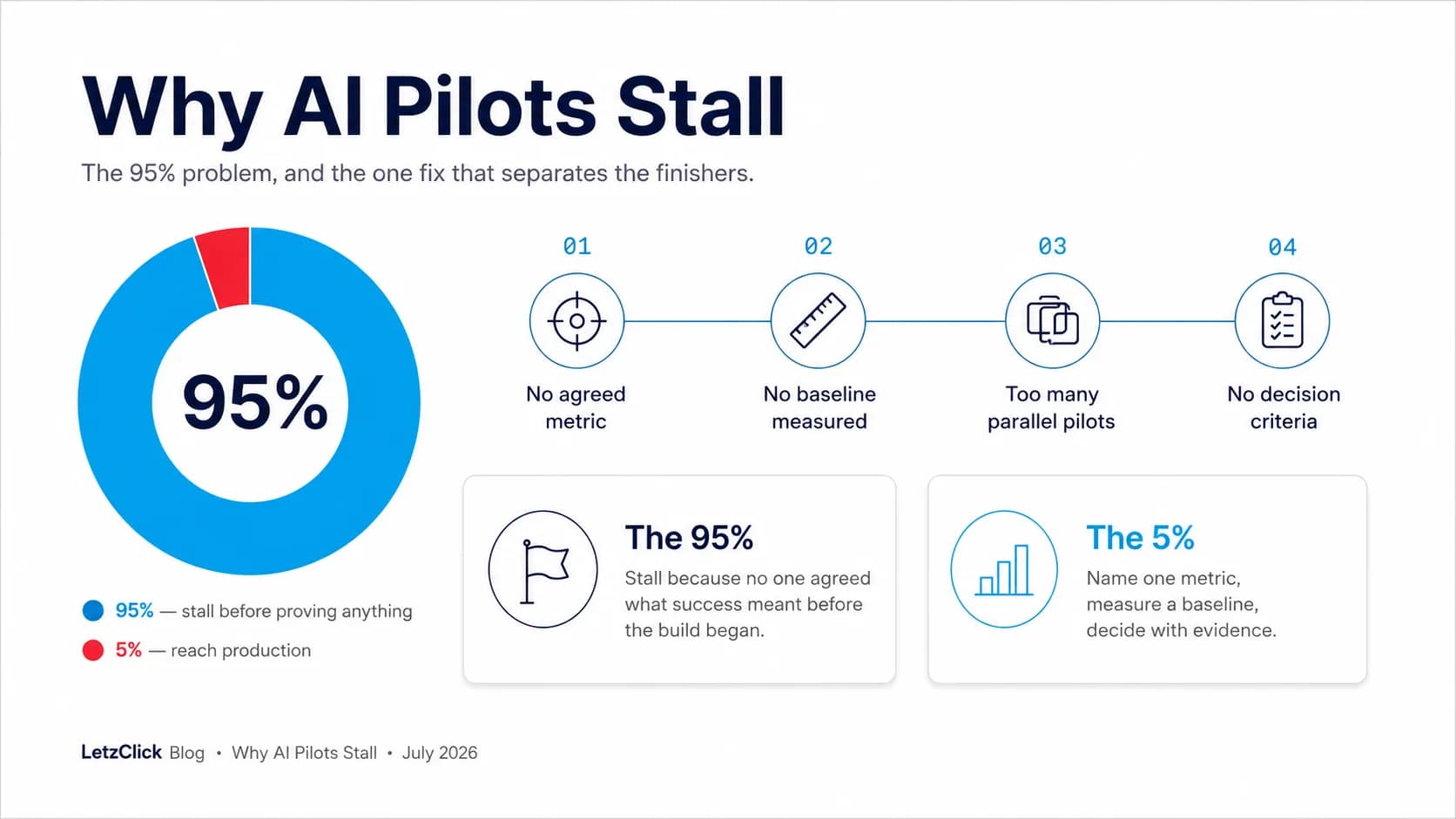
The “95% of AI pilots fail” claim comes from a preliminary 2025 Project NANDA report. It examined more than 300 public AI initiatives, interviewed representatives from 52 organisations and gathered responses from 153 senior leaders. Its most repeated number was a 5% success rate for embedded or task-specific generative-AI initiatives. You can read the archived original report and see why the distinction matters.
The headline is useful only if its denominator and definition travel with it. Project NANDA did not evaluate every AI pilot in every sector. It combined public-company research with interviews and survey evidence gathered from January to June 2025. The authors describe the results as directional. Definitions varied between organisations, and selection and self-reporting can affect the picture. This is evidence worth taking seriously, not a universal failure law.
The 5% figure applies to embedded, task-specific GenAI initiatives that were reported as successfully implemented. Success meant users and executives saw marked, sustained productivity gains and/or an impact on profit and loss. That threshold is more demanding than completing a demonstration, opening a tool to users or moving something behind a production URL.
The report presents a 60/20/5 progression for these enterprise initiatives: roughly 60% were investigated, 20% reached a pilot and 5% were successfully implemented. Those figures are stages in the report’s directional synthesis, not proof that a single, representative cohort of all global AI projects moved through one funnel.
The same report describes a different pattern for general-purpose LLM tools: around 80% were explored or piloted and about 40% were deployed. That contrast is important. An employee can start using a flexible chat tool with little integration. A task-specific system has to fit data, permissions, exceptions, ownership and the way work actually moves.
The report’s central concern is the learning gap. Many enterprise tools are brittle: they do not retain useful context, adapt to feedback or improve inside the workflow. Interviewees also raised integration effort, workflow mismatch, weak user experience, model-output concerns, sponsorship and change-management problems. These are recurring themes in the evidence, not experimentally proven causes for every failed initiative.
That explains why a capable model can still produce a weak business system. The hard part begins after the impressive answer: connecting the tool to reliable context, deciding what happens when confidence is low, fitting it into an existing process, earning frontline adoption and assigning someone to own the result.
The report’s warning is about workflow fit and learning, not a universal verdict on AI.
Project NANDA supports a practical direction: start with a bounded workflow, prefer systems that can use relevant context and feedback, involve the people doing the work, integrate with the real operating environment and hold implementation accountable to a business outcome. It also suggests that buying a generic tool and building a task-specific system are different adoption problems.
It does not show that the successful 5% chose one metric in week one, baselined it for two weeks or followed LetzClick’s six-week sequence. Those are our measurement disciplines. They are designed to turn an implementation into a decision, but they should not be presented as Project NANDA findings.

We begin with one workflow, one team and one decision owner. We write down the current process, the data available, the exceptions that matter and the point where a person must stay in control. Only then do we decide whether AI is the right tool.
If it is, we choose one business measure that can support a scale, refine or stop decision. Examples include median handling time per complete case, percentage of first-pass work accepted without rework, or hours spent preparing a recurring deliverable. The measure needs a clear definition, a named owner and enough observations to establish a credible baseline.

This discipline does not guarantee success. It makes the result interpretable. If the number improves without unacceptable quality, risk or adoption costs, there is evidence to scale. If it does not, refining or stopping is a legitimate result. Read our guides to choosing the pilot metric and deciding when not to build with AI for the full decision framework.
If you need to separate a useful workflow test from a headline-driven AI project, book a meeting. We will help frame the decision, and we will tell you when the evidence says not to build.
Co-founder-led strategic consulting in AI and digital transformation for Luxembourg SMEs.