
What the “95% of AI pilots fail” claim actually means
 Maroun Altekly8 min read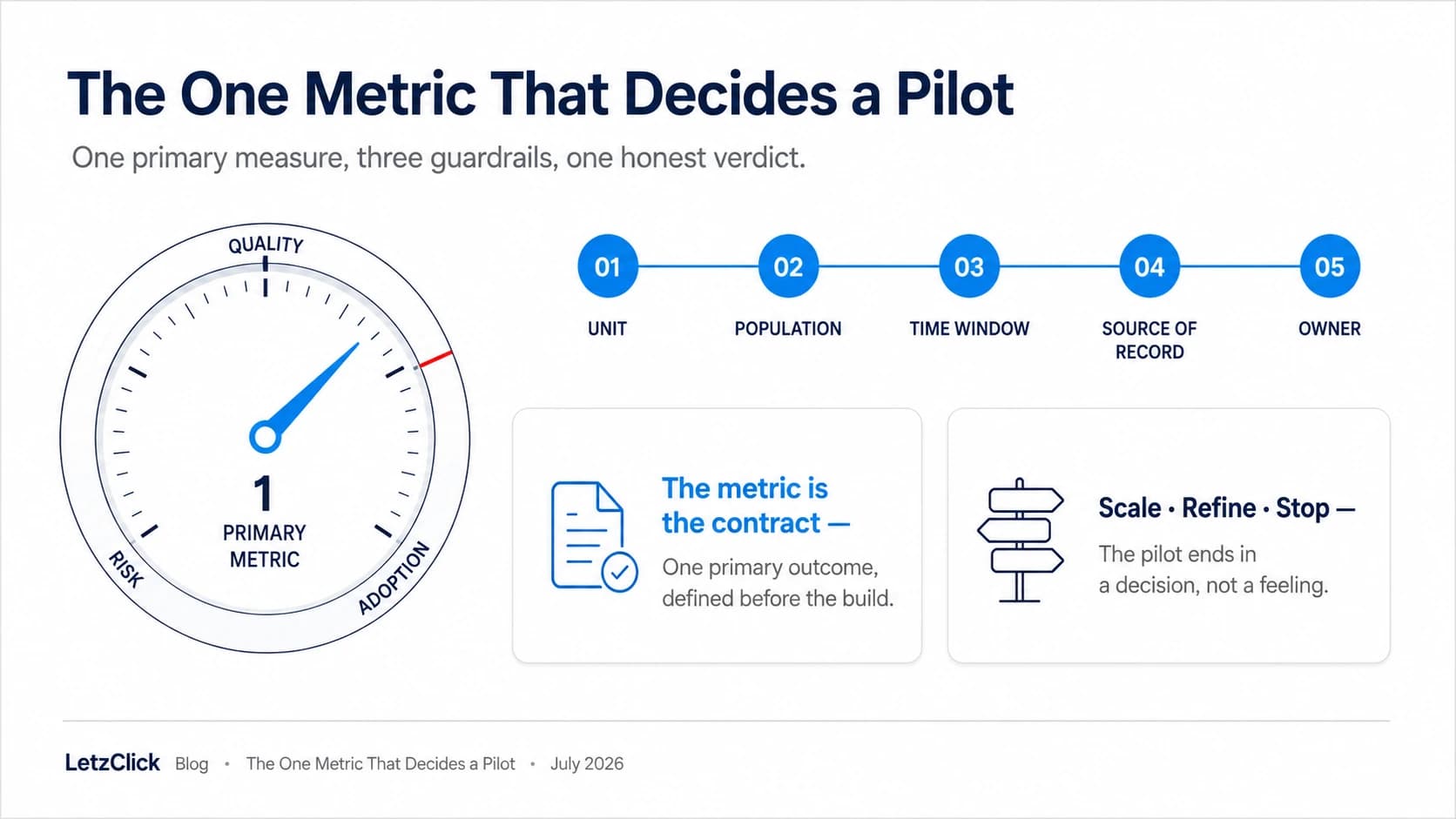
The AI pilot metric is the highest-leverage decision in the engagement. The model, interface and workflow may change, but the decision the pilot must support should not. One primary measure gives the work a boundary and leadership a shared language for the final review.
One metric does not mean ignoring quality, safety or adoption. Choose one primary business outcome and treat the rest as guardrails. A faster process that creates more corrections, or an accurate tool nobody uses, is not a clear win. The primary measure shows whether value moved; guardrails stop hollow claims.
Write the decision the metric needs to unlock: if the result clears an agreed bar without breaking a guardrail, we scale; if the direction is promising but the mechanism is unclear, we refine; if the result does not move or the operating cost is unacceptable, we stop. This sentence forces the team to say what the pilot is for before choosing a convenient number.
Then name the workflow precisely. “Improve customer service” is too broad. “Reduce the time from receiving a complete warranty request to sending the first usable response” is measurable. The narrower version identifies the starting event, ending event and unit of work. It also exposes what the pilot does not cover.
The metric is the contract: one primary outcome, defined before the build, interpreted with explicit guardrails.
A usable metric needs five written elements. First, the unit: minutes per complete case, accepted proposals per week or cost per resolved request. Second, the population: which case type, team, language or channel is included. Third, the time window. Fourth, the source of record. Fifth, the person who owns the number and can explain anomalies.
For example, “time saved” is not yet a metric. “Median staff minutes from opening a complete supplier invoice to posting a reviewed entry, for invoices handled by the finance team, measured from the workflow log” is much closer. It excludes incomplete invoices, names the process and avoids relying only on memory. Whether median or average is appropriate depends on the workflow; choose deliberately and keep the calculation unchanged.
Revenue may matter most to the business, but it is often too far downstream for a short pilot. Many other factors affect it. Move upstream until the pilot can plausibly influence the measure, while staying downstream enough to represent business value. Proposal preparation time may be a better pilot metric than revenue; approved proposals without material rework can be a guardrail. For a support workflow, time to a usable resolution may be primary, with reopen and escalation rates as guardrails.
Avoid activity metrics that become impressive without improving the work: prompts sent, documents generated, users invited or model tokens consumed. Adoption can be an important guardrail, but usage alone does not show that the workflow became better. Likewise, model accuracy without a defined task, review rule and business consequence is too abstract to decide an implementation.
Record the current process using the same definition and source you will use during the pilot. Include normal work, not a hand-picked set of easy cases. Note unusual periods, missing records and process changes that could distort the comparison. If the workflow is seasonal or low-volume, a six-week result may be directional rather than decisive; say so instead of manufacturing certainty.
A clean before-and-after comparison is not automatically causal proof. Staff attention, backlog changes, training and case mix can all influence the number. When possible, keep the population stable, document simultaneous changes and inspect the underlying cases. The goal is a decision-grade signal, not a scientific claim the data cannot support.
Do not invent a target because it sounds ambitious. Work backwards from the economics and operating reality. How much movement would justify implementation, maintenance, review and change-management effort? What quality floor cannot be crossed? Which error requires human escalation? Write those rules before the first build review, while everyone is still willing to accept an unfavourable result.
Review the same metric each week, but do not move the finish line. Weekly reviews are for diagnosing the workflow: where time is lost, which cases fail and whether users bypass the tool. If the original metric proves invalid, document why and reframe the pilot openly. Quietly swapping metrics turns a test into a sales narrative.
Scale when the primary metric clears the agreed bar, guardrails hold and the operating owner accepts the new workflow. Refine when there is a credible signal but a bounded problem remains, such as one case type or integration step. Stop when value does not move, risk is unacceptable, the data cannot support the workflow or the solution costs more attention than it removes.
This is the measurement layer of the LetzClick methodology. See how it fits into a six-week AI pilot, read why the widely repeated 95% pilot-failure claim needs context, or use the when-not-to-build checklist before selecting a metric.
If your team has several candidate measures and no shared decision rule, book a meeting. We will help narrow the workflow and define what evidence would be strong enough to act on.
Co-founder-led strategic consulting in AI and digital transformation for Luxembourg SMEs.