

What the “95% of AI pilots fail” claim actually means
 Maroun Altekly8 min read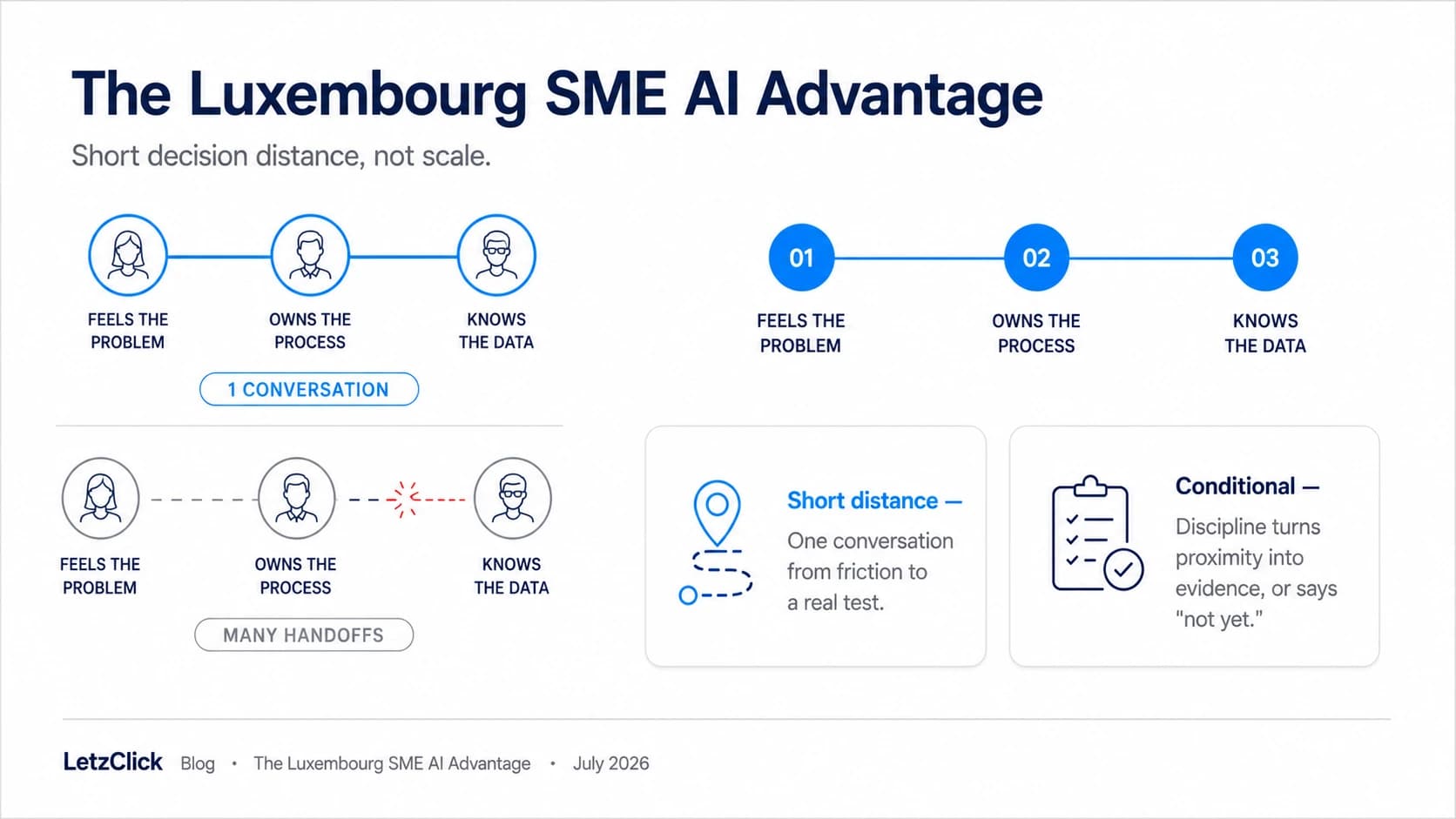
The Luxembourg AI advantage for SMEs is a short distance between the person who feels the problem, the person who owns the process and the person who can authorise a change. Enterprise AI is often framed as a scale game involving more data, specialists and budget, but decision distance can matter more at the start of a practical implementation.
In an owner-led Luxembourg SME, those people may be only one conversation apart. That can shorten the path from “this task wastes time” to a test on real work. It is not a guarantee. Some small businesses are just as fragmented as large ones, and a short reporting line cannot compensate for missing data, unclear responsibility or a workflow that should not use AI.
The advantage is not being small. It is being able to bring the right people to one decision without losing the context between them.
First, the operator can explain the exceptions before they become development surprises. A process map may say that every request follows the same route; the person doing the work knows which client types, languages or missing documents change it. That knowledge is essential when defining what the system may automate and when it must ask for review.
Second, the decision owner can set a boundary quickly. Instead of collecting a catalogue of ideas, the team can choose one workflow and one result worth testing. Third, feedback can travel back to the build without passing through several reporting layers. A bad draft, confusing handoff or missing field can be examined in context while the pilot is still small.
Many Luxembourg SMEs work across French and English, sometimes with additional languages, while serving clients with different expectations and document formats. A workflow that looks uniform in a diagram may behave differently by language or channel. Treat multilingual work as part of the test definition, not a cosmetic translation step added at the end.
The market’s proximity can also blur roles. A founder may sell, approve exceptions and hold client history at the same time. That creates speed, but it also creates key-person risk. Before adding AI, write down the decision rules, source material and escalation path that currently live in one person’s memory. Otherwise the tool will reproduce an undocumented mosaic rather than create a transferable system.
Start with observed friction, not a tool. Ask the people doing the work which repeated task creates delay, rework or avoidable handoffs. Choose one case type with enough recurring work to learn from. Exclude high-risk exceptions from the first scope unless the purpose of the test is specifically to understand them.
Put three responsibilities in the room: the workflow operator, the decision owner and the person who understands the data or system of record. In a very small company, one person may hold two roles, but name the roles anyway. This prevents a technical build from quietly making an operational or risk decision.
Write the current workflow before designing the future one. Record the starting event, ending event, inputs, languages, common exceptions, approval points and source of truth. Mark where judgement is necessary and where a deterministic rule or ordinary integration may solve the problem more reliably than AI.
Then choose the smallest intervention that could move one business metric. For a multilingual enquiry workflow, the test might classify a defined request type and draft a response from approved source material, while a person remains responsible for sending it. The primary measure could be time to a usable first response; guardrails could track material corrections and escalations. This is an example of framing, not a promised result.
Run the test in the real workflow with a clear stop condition. Review failed and bypassed cases, not only successful demonstrations. At the end, decide whether to scale, refine or stop. The SME advantage disappears if a pilot continues indefinitely because the founder likes the idea or the vendor wants another phase.
A smaller data set may not represent rare cases well. One busy employee may have too little capacity to test and document the change. A single system owner may also become a new bottleneck. Security, privacy, contractual and sector-specific duties do not shrink with headcount. If the workflow touches sensitive or consequential decisions, bring the relevant expertise into the scope and preserve meaningful human control.
Do not confuse speed with permission to skip governance. Keep access narrow, use approved data sources, document who can override the system and decide how errors are reported. If the evidence is too thin or the review burden removes the expected benefit, “not yet” is a responsible outcome.
LetzClick’s methodology uses this sequence: structure the workflow, test one opportunity, measure one primary outcome and act on the result. Our AI consulting service is designed around owner-led SMEs, while the guide to choosing one pilot metric makes the measurement step concrete.
Before committing to a build, use the when-not-to-build checklist. If the workflow survives those checks and you want an independent read on the first scope, book a meeting. The first objective is clarity, including clarity that AI is not the right next move.
Co-founder-led strategic consulting in AI and digital transformation for Luxembourg SMEs.